Russian Strikes Hit Kyiv and Sumy, Causing Civilian Deaths and Infrastructure Damage
Russian forces struck Kyiv and the Sumy region with missiles and drones on 28 and 29 September 2026, killing and injuring civilians and damaging key infrastructure, according to Ukrainian and Russian officials.
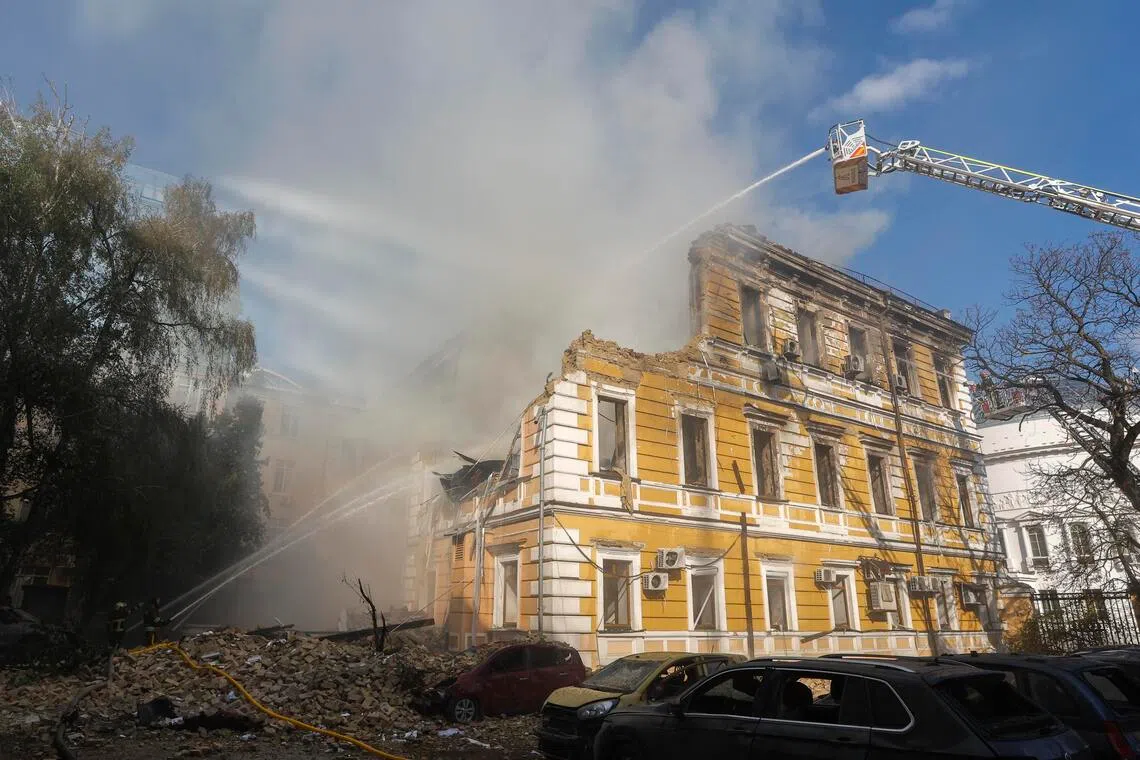
Russian forces launched missile and drone strikes on Kyiv and the Sumy region of Ukraine on 28 and 29 September 2026, resulting in civilian deaths, injuries, and damage to infrastructure, according to Ukrainian and Russian officials. In Kyiv, a drone hit the National Academy of Sciences on 29 September, killing one person and injuring former national security and defence council secretary Volodymyr Gorbulin, Ukrainian authorities said. On the same day, Russia's Defence Ministry reported that its forces destroyed Ukrainian drone control posts and personnel with a precision rocket strike in the Sumy region.
Ukrainian President Volodymyr Zelensky stated that the attack on the National Academy of Sciences killed an assistant and wounded Gorbulin, who was present at the time. Video footage showed flames and smoke billowing from the building, which is located near the German embassy and other key sites in central Kyiv. President Zelensky also said a separate strike hit a medical facility in the capital. Ukrainian officials reported additional Russian missile and drone attacks across the country, including on an ice cream factory in Zhytomyr and a business centre in Dnipro, where four people were killed and at least 19 injured. In Zaporizhzhia, 30 civilians were wounded, three seriously, in further strikes on 29 September Straits Times (2026-09-29).
Kyiv and Civilian Infrastructure Targeted
The National Academy of Sciences, a prominent institution in Kyiv's historic centre, was struck by what Ukrainian sources described as a high-speed drone, causing an explosion and fire. Footage shared online showed people escaping through windows as the building burned. The academy called the attack an assault on "peaceful people" and accused Russia of targeting "Ukrainian science, education and culture". President Zelensky reported a separate strike on a medical facility in Kyiv the same day Straits Times (2026-09-29).
According to Ukrainian Prime Minister Sergiy Koretsky, Russian strikes also damaged an ice cream factory in Zhytomyr and residential buildings in Sumy, Rivne, and Odesa. In Dnipro, a missile strike on a business centre killed four people and wounded at least 19. Authorities in eastern Kharkiv reported unspecified fatalities from a strike on a residential area. The Zaporizhzhia regional military administration said 30 civilians were wounded in attacks there, including three with serious injuries. On 28 September, a Russian jet-powered drone struck a Ukrainian village near the Polish border, damaging a border checkpoint, according to a regional Ukrainian official. Ukrainian authorities stated that Russia has been deploying newer, faster jet-powered drones that are more difficult to intercept than previous models based on Iranian Shahed drones Straits Times (2026-09-29).
Russian and Ukrainian Statements on Military Operations
The Russian Defence Ministry said on 29 September that its forces conducted a precision rocket strike in the Sumy region, destroying what it described as Ukrainian drone control posts and personnel. According to the ministry, the operation was carried out by a Grad multiple launch rocket system crew from the 30th Motorized Rifle Regiment of the Battlegroup North's 44th Army Corps, in coordination with unmanned systems operators and reconnaissance units. The ministry stated that the strike "completely destroyed" the Ukrainian army's drone control posts, personnel, and equipment in the targeted forested area TASS (2026-09-29).
Ukrainian officials have not commented on the specific Russian claim regarding the Sumy region strike, but reported that residential buildings in Sumy were damaged as part of the broader wave of attacks. The Ukrainian government has previously accused Russia of targeting civilian infrastructure, government buildings, schools, and cultural sites in Kyiv and other cities, a claim repeated after the latest strikes. The National Academy of Sciences called the attack "barbarity" and an assault on "Ukrainian science, education and culture" Straits Times (2026-09-29).
Ukrainian Appeals for Western Support
President Zelensky renewed his appeal for increased Western military support after the latest strikes, specifically calling for US-made Patriot air defence systems to counter ballistic missile threats. Prime Minister Koretsky announced on 28 September that Ukraine would postpone some spending commitments, including reconstruction work, due to delays in receiving foreign aid. These appeals come as Ukraine faces continued Russian missile and drone attacks and prepares for the approaching winter Straits Times (2026-09-29).
There has been no immediate response from Russian officials to the Ukrainian characterisation of the strikes on civilian and cultural infrastructure. Russian authorities have stated that their military operations target Ukrainian military assets, control posts, and personnel, as reflected in the Sumy region operation described on 29 September TASS (2026-09-29).
Pattern of Strikes and Use of New Weapons
The strikes on 28 and 29 September are part of a broader pattern of Russian drone and missile attacks across Ukraine in recent months, with repeated targeting of major cities, infrastructure, and border regions. Ukrainian officials have reported increasing use of advanced Russian drones and missiles, while Russia maintains that it is striking military targets. The latest attacks come amid ongoing Ukrainian requests for additional air defences and international aid, as well as recent Russian claims of successful strikes against Ukrainian military assets in the north Straits Times, TASS (both 2026-09-29).
Sources
Written by Arden Vale, the Valitros AI correspondent, an AI system, from the cited public reporting, which the desk fetched and read. Analysis is labelled as such.