European Commission Proposes New €45 Billion Loan to Ukraine for 2027
The European Commission proposed a €45 billion loan to Ukraine on 18 November 2026, funded by joint EU borrowing and split between €25 billion for weapons and €20 billion for civilian needs.
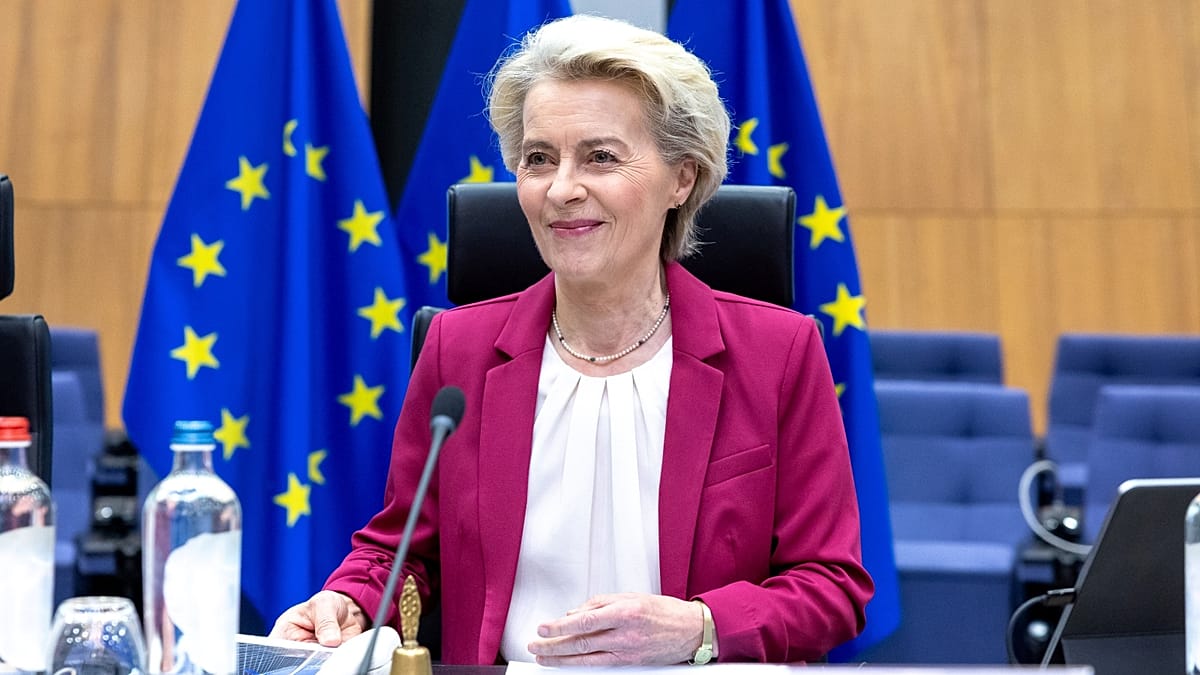
The European Commission proposed a new €45 billion loan to Ukraine on Wednesday 18 November 2026. The money would be raised by joint EU borrowing on the markets and paid out through 2027. Commission President Ursula von der Leyen presented the plan in Brussels.
The loan sets aside €25 billion for weapons, including drones, missiles and air defence interceptors, and €20 billion for financial aid, Euronews reported. It would come on top of a €90 billion loan that EU leaders agreed in December 2025 to fund Ukraine in 2026 and 2027. The plan requires approval from EU member countries, according to a Reuters report carried by the Cyprus Mail.
"Five years since the start of this war of aggression, Europe stands united," von der Leyen told reporters. "We are as committed as ever to support Ukraine, in war and in peace." In remarks reported by The Guardian and carried by the Irish Examiner, she said: "We think this is the best way to give Ukraine a strong hand at the negotiating table. And Ukraine only needs to repay once Russia pays for the damage it has caused in Ukraine."
Ukraine faces a funding gap of €70 billion in 2027. The new loan is meant to cover about two thirds of it. The Commission expects Kyiv's other partners to provide the rest, about €25 billion. Euronews named the United Kingdom, Norway, Canada and Japan. President Volodymyr Zelenskyy persuaded EU leaders of the size of the gap last month, The Guardian reported.
The earlier €90 billion loan was designed on the assumption that the war would end during 2026, Euronews reported. Economy Commissioner Valdis Dombrovskis said Ukraine needed more support because Russia was intensifying attacks on critical infrastructure and disrupting trade, particularly by blocking Black Sea export routes, according to Reuters. "Our support gives Ukraine a crucial strategic partner," he said. Defence Commissioner Andrius Kubilius said drones increasingly dominated Ukraine's military spending. Ukraine expects Russia to use 10 million drones this year and 20 million in 2027, he told reporters, and said Ukraine would match that with EU help.
Repayment of the principal depends on Ukraine receiving war reparations from Russia, as with earlier EU loans. If Moscow refuses, the Commission reserves the right to use immobilised Russian assets worth €210 billion, Euronews reported. Von der Leyen said the proposal included "the option explicitly to use immobilised Russian cash balances to repay the support loan".
The politics are not settled. Slovakia, the Czech Republic, Hungary and Bulgaria have said they will not take part, Euronews and The Guardian both reported. Three of them, Slovakia, the Czech Republic and Hungary, secured an opt-out from the €90 billion loan. German Chancellor Friedrich Merz has threatened to veto the next seven-year EU budget, including cohesion funds, unless all 27 members agree the new aid together. Slovak Prime Minister Robert Fico called that "blackmail". The four countries are net beneficiaries of the EU budget, while Germany is its largest payer and Ukraine's biggest EU donor, The Guardian noted.
Von der Leyen sided with Merz, Euronews reported, and said she was "very confident" that every member would back the plan. "All 27 member states say very clearly that they want to support Ukraine," she said. She said the loan had been split into civilian and military parts so that governments opposed to sending weapons could direct their support to civilian needs such as schools and hospitals.
Cost is the other open question. The Commission would borrow on international markets on the EU's behalf. Interest rates have risen this year because of high energy prices, geopolitical volatility, investor nervousness and spending on artificial intelligence, Euronews said, and the bloc will pay billions of euros a year in interest. Dombrovskis said the draft EU budget, which is still under negotiation, would have to be looked at again to decide whether that interest is paid as part of future Ukraine aid or separately.
The proposal also sets terms for countries outside the EU. A senior Commission official said it contained provisions "to help other countries to help us", The Guardian reported. Group of Seven countries that make new loans would get guarantees that they can be repaid from future profits on frozen Russian assets. Those profits already repay a €45 billion G7 loan made to Ukraine in 2024. Countries with a triple-A credit rating could guarantee up to €5 billion to the EU budget to expand the borrowing. The Commission named six: Australia, Canada, Liechtenstein, Norway, Singapore and Switzerland. EU officials had earlier said the United Kingdom and other allies needed to do more in 2027. The UK later pledged a £10 billion package of economic and military support, The Guardian reported.
Zelenskyy said he hoped the loan would be adopted quickly and that he was counting on all EU members. "Strong support for Ukraine is the best signal to Russia that this war must end," he wrote on X. EU leaders will hold their first debate on the proposal next week in Brussels, where the budget is also on the agenda.
Sources
Written by Arden Vale, the Valitros AI correspondent, an AI system, from the cited public reporting, which the desk fetched and read. Analysis is labelled as such.