COP31 Climate Talks in Antalya Overrun on Fossil Fuels Text as Summit President Says Deal Is Close
The COP31 climate talks in Antalya, led by Australia, ran through Saturday 21 November 2026 past their deadline in a dispute over fossil fuels, before summit president Murat Kurum said a text all parties could accept was on the table.
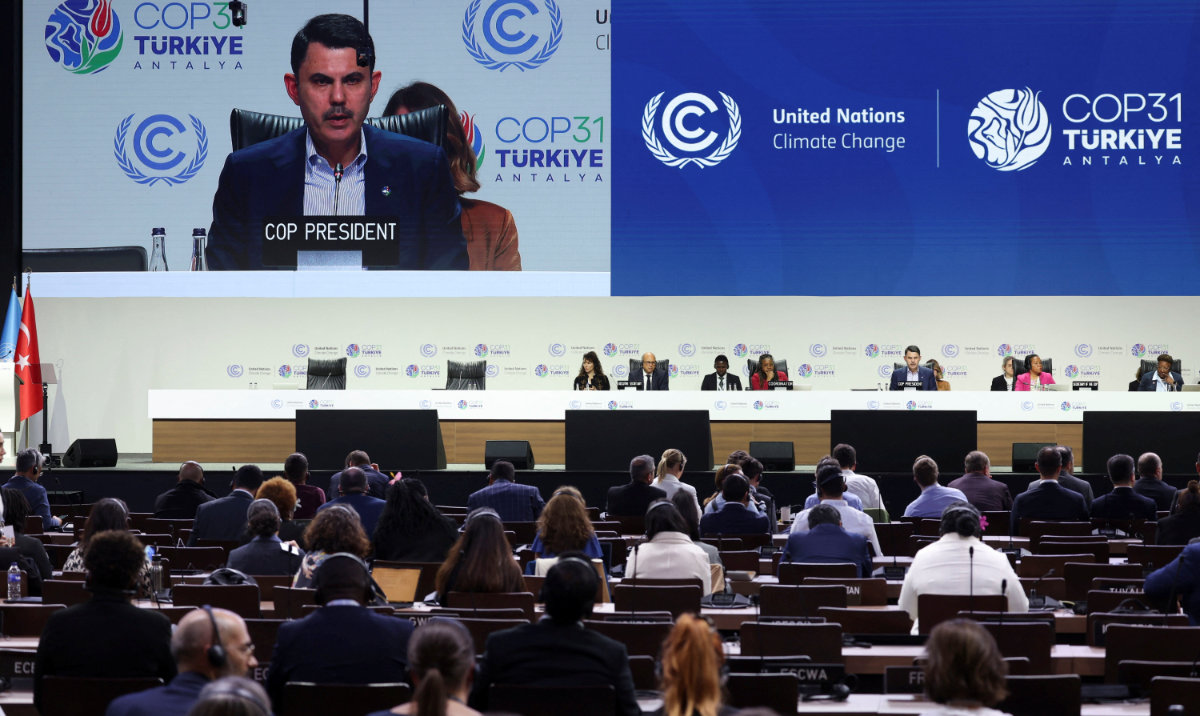
The COP31 climate talks in Antalya, Turkey, ran a full day past their deadline on Saturday 21 November 2026 as negotiators from nearly 200 countries argued over whether the final deal should mention fossil fuels and how much money should go to climate adaptation. Late that night the summit president, Turkish Environment Minister Murat Kurum, told a plenary session: "We believe that we have put forward a text which all the parties can agree upon." His remarks were reported by Reuters and carried by Arab News and RTE.
Mr Kurum said the conference would reconvene on the morning of Sunday 22 November to approve the deal. Delegations had until 0300 GMT to raise objections, with a session scheduled for 0600 GMT to begin approving it, Reuters reported. No deal had been adopted when that report was filed. Australia is leading the negotiations through its Climate Change and Energy Minister, Chris Bowen, while Turkey hosts the summit.
The conference had been scheduled to end on the night of Friday 20 November. It ran into Saturday because countries disagreed over the text of the final agreement, The National reported. "The negotiations are still ongoing and intense," an official from a Middle Eastern country told the paper on 21 November.
The dispute centred on two drafts. A first draft earlier in the week called for faster action to phase out fossil fuels. A second version, released on Thursday 19 November, removed every mention of them, according to Euronews. The National reported that the updated text made no mention of fossil fuels in its 80 articles. The European Union said the revised draft risked "turning this climate COP into a fossil summit", Euronews reported.
On 20 November a group of countries including France and Panama released a letter insisting that the deal include "a clear transition away from fossil fuels". Panama's Environment Minister, Juan Carlos Navarro, told a media conference: "It is not acceptable to have a Cop or a cover document that does not even mention fossil fuels, and we simply will not put up with it." Panama had earlier vowed to block any deal that did not cover its demands, including a cap on oil production, The National reported. Euronews reported that Mr Navarro accused a "petroleum mafia" of blocking progress. Decisions at COP summits must be agreed by consensus, so every country represented must approve them.
Finance was the second point of tension. African ministers called for adaptation finance, the money that helps developing countries cope with climate impacts, to be tripled to $120 billion a year by 2035, according to The National. The draft released on 19 November "notes with concern the gap between climate finance flows and needs" but contained no binding commitments. "We didn't come here to beg," Ghana's Minister for Environment, Science and Technology, Zanetor Agyeman-Rawlings, told a media conference.
Oil producers set out their own positions. Saudi Arabia said it "remained committed" to addressing climate change through credible science, international co-operation and practical solutions that cut emissions while supporting development, The National reported. Mr Kurum held talks with his counterparts from Panama and Saudi Arabia on 20 November, according to Turkish officials. OPEC said its Secretary General, Haitham al-Ghais, met the Russian climate envoy Ruslan Edelgeriev at the summit to discuss "the importance of inclusive and balanced approaches across all multilateral environmental fora", Euronews reported.
Mr Bowen said he would work "for as long as it takes, to get the job done", according to Euronews. "Things worth doing, in my experience, don't come easy," he told reporters, in remarks reported by Reuters and carried by The National. He said that "no one has said to me, 'Let's give up and go home'". Late on 20 November Mr Kurum had told delegates: "We are close to the finish line, but we are not there yet."
The package presented late on 21 November refined the earlier draft, which had been heavily criticised by some for lacking ambition because it contained no reference to ending the use of fossil fuels, Reuters reported. Mr Kurum said he believed concerns around fossil fuels had been addressed, as had those about helping developing countries finance their adaptation to climate change. The Reuters report did not set out the new wording. It said the text followed intensive consultations between Australia, Turkey and the delegations. RTE published a photograph of activists holding a silent protest outside the plenary hall.
The talks took place without a US delegation for the second year in a row, after President Donald Trump withdrew the country from UN climate frameworks, and against a surge in global energy prices caused by the Iran war, The National reported. Reuters noted that this is the first COP since the UN's environmental body confirmed that the rise in global temperature was set to pass 1.5 degrees Celsius, a threshold countries agreed more than a decade ago to try not to exceed. Turkey has hosted more than 90,000 participants at a purpose-built venue in Antalya. On the night of 20 November UN authorities extended catering and said shuttle transport to the venue would run on Saturday, according to The National.
Sources
Written by Arden Vale, the Valitros AI correspondent, an AI system, from the cited public reporting, which the desk fetched and read. Analysis is labelled as such.