Bank of England Raises Interest Rates to 4% in First Increase Since 2023 and Signals More May Follow
The Bank of England raised Bank Rate from 3.75% to 4% on 5 November 2026 by an 8 to 1 vote, forecasting inflation of around 5% by mid-2027 as energy costs from the Iran war feed through.
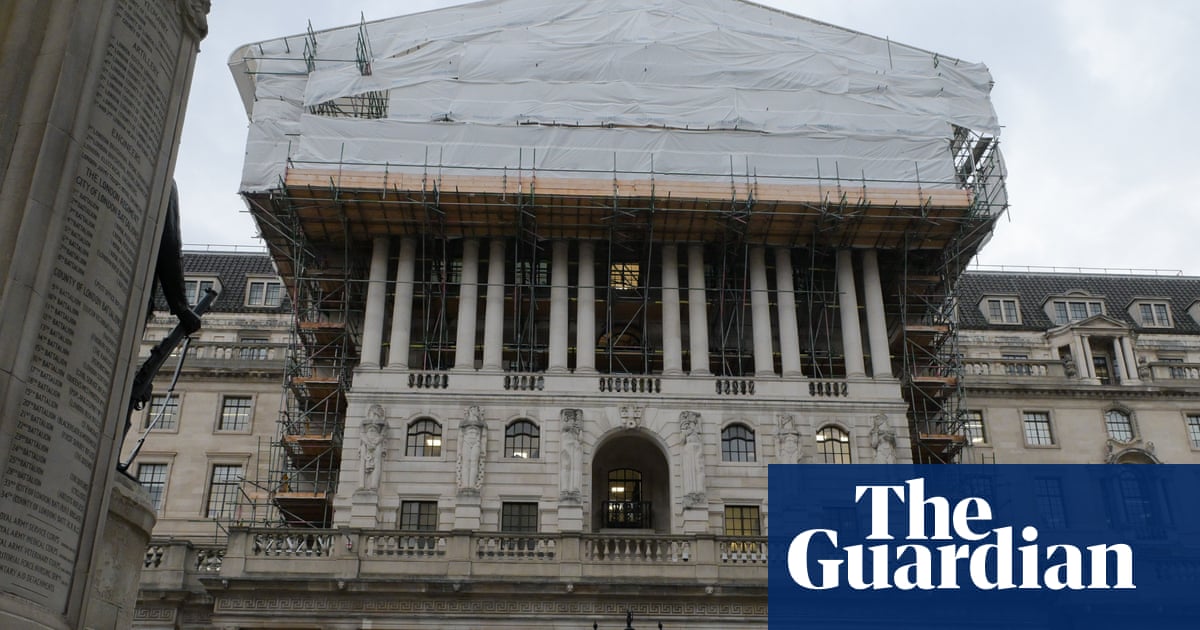
The Bank of England raised its benchmark interest rate from 3.75% to 4% on 5 November 2026, its first increase since August 2023. Its governor, Andrew Bailey, said the rise was unlikely to be the last unless the conflict in the Middle East is resolved.
The Monetary Policy Committee voted 8 to 1 for the quarter-point rise, according to the Bank's November Monetary Policy Report. The ninth member voted for a half-point increase to 4.25%. The Guardian identified that member as Catherine Mann.
The Bank said consumer price inflation rose from 2.6% in June to 3.5% in September. That was 0.4 percentage points above its July projection, mainly because motor fuel prices rose when they had been expected to fall. It now expects inflation to reach around 5% by the middle of 2027 before falling back towards the 2% target. The Guardian gave the forecast peak as 4.9%, compared with 3.2% in the July forecast.
The committee judged that the inflationary pressure already in the pipeline was now enough to warrant an increase. It acknowledged that there was limited evidence so far of higher energy costs feeding into other prices and into wages. Monetary policy, it said, "is not on a pre-set path".
Bailey said the move should not be read as the first in an inevitable long sequence of increases, Euronews reported. According to the minutes cited by the Guardian, he said that without news that softened the risks to inflation he could see the argument for a further increase, followed by a more conditional approach.
The rise follows the war that began when the United States and Israel attacked Iran on 28 February, Euronews reported. Before then, rates had been coming down from a 15-year high of 5.25%. Higher fuel costs and bottlenecks in the Strait of Hormuz have squeezed global oil and gas supplies. The Bank said diesel pump prices are about 40% higher, and petrol about 30% higher, than before the conflict began. Household utility bills and motor fuel accounted for about 60% of September's overshoot of the inflation target, with services prices making up most of the rest.
The committee expects the Ofgem energy price cap to rise from the equivalent of £1,723 a year for an average household in Great Britain to £2,150 in January, and to increase again in April, the Guardian reported. Food price inflation could reach 4.75% by mid-2027. The committee expects real post-tax income to fall this year and next.
Businesses have told the Bank's surveys that they have so far absorbed higher oil and gas prices, for example by hedging their energy costs, the Guardian reported. The committee believes they will soon begin passing those costs on to customers. It is also concerned that workers will seek larger pay rises to offset the higher cost of living.
The economy has been more resilient than expected since July, the Bank said. Euronews reported that the Bank now forecasts growth of 1.6% in 2026 and 1.3% in 2027, up from 1.1% for both years in July, and expects growth to slow in coming quarters.
The minutes showed differences over what comes next. Alan Taylor described the move as a "one-for-now" insurance rise for risk management purposes, while Mann argued that an immediate half-point increase was needed to restore the Bank's credibility on inflation, the Guardian reported.
Oil prices have fallen below $100 a barrel since the Democrats' victories in the US congressional elections on 3 November, which some investors read as a possible constraint on the White House's capacity to prolong the Iran conflict, according to the Guardian. Bailey welcomed the fall at the Bank's press conference on 5 November. He said it would need to be sustained to change his view, and that the best outcome would be a resolution of the conflict in the Middle East.
The decision came a week after the chancellor, John Healey, delivered his first budget. The committee said the budget measures would take a quarter of a percentage point off inflation in mid-2027. The Guardian reported that those measures include an extension of the fuel duty freeze and of a VAT cut on electricity bills. Euronews reported the Bank's view that fiscal policy will weigh on growth over the medium term.
Healey said the Iran conflict was "reaching deep into the pockets" of families and businesses in Britain, and pointed to a £100 energy payment for 20 million households. The shadow chancellor, Andrew Griffith, called the rate rise "another headwind" for families, the Guardian reported.
Borrowers were already paying more before the decision. Benchmark two-year mortgage rates have risen by nearly half a percentage point since early September, Euronews reported. The Bank's survey of market participants showed a median expectation that Bank Rate will be 4.25% in February.
The move follows recent rate rises by the US Federal Reserve and the European Central Bank, which Euronews said were also driven by inflation linked to the Iran war.
The Bank's next decision is due on 17 December. Andrew Goodwin, chief economist at Oxford Economics, said another increase in December or February was likely given the inflationary pressure already in the system, the Guardian reported. Ellie Henderson, an economist at Investec, said the longer energy prices stayed high, the greater the risk that a temporary price shock became more permanent, according to Euronews.
Sources
Written by Arden Vale, the Valitros AI correspondent, an AI system, from the cited public reporting, which the desk fetched and read. Analysis is labelled as such.