EU and UK Seal Deals on Food Trade, Emissions and Youth Mobility at Brussels Summit
Prime Minister Andy Burnham and EU leaders announced three agreements in Brussels on 20 November 2026, but the EU tied final approval to a settlement on tuition fees for European students.
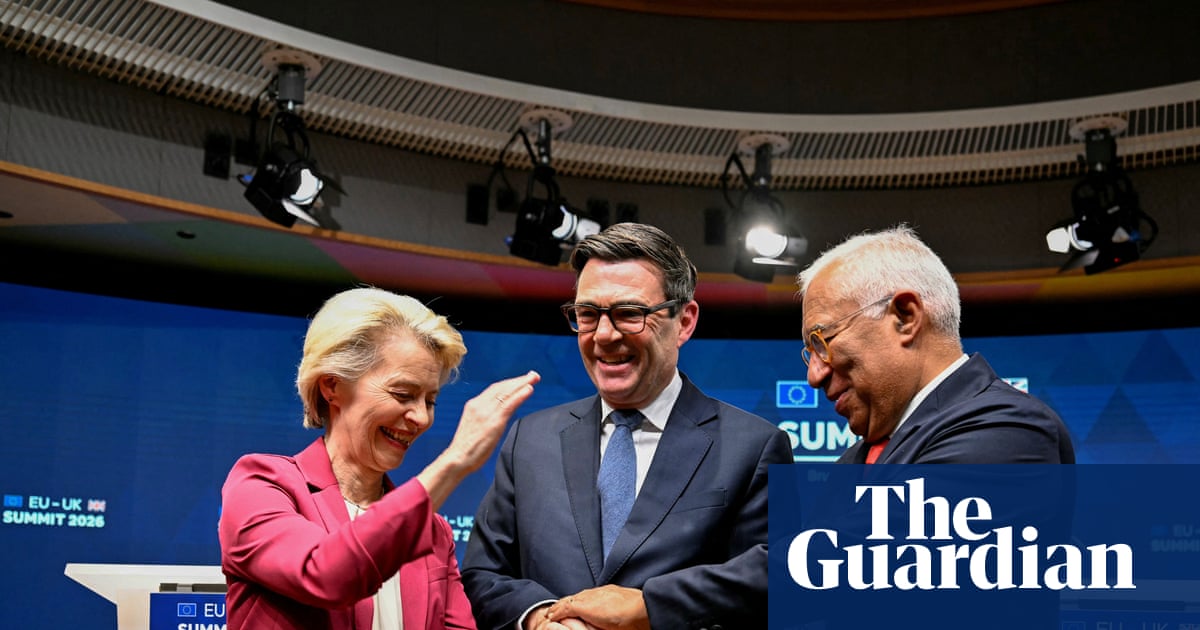
The European Union and the United Kingdom announced three agreements at a summit in Brussels on Friday 20 November 2026: a deal to ease checks on food and drink trade, a link between their emissions trading schemes and a youth mobility scheme. British Prime Minister Andy Burnham, European Commission President Ursula von der Leyen and European Council President António Costa presented the package after what the Guardian described as late-night talks.
The EU attached a condition. In a separate statement seen by the Guardian, the Council and the Commission said they would not adopt the three agreements until negotiations had concluded on equal treatment for EU students on tuition fees at British universities. Burnham rejected the link. "The deal is done," he said, adding that legislation would enter Parliament in the week after the summit.
Under the youth experience scheme, up to 100,000 British people a year would be able to live, work, travel and study in the EU for up to three years, with the same number of young Europeans able to come to the UK, according to a Guardian explainer. It said young people should be able to use the scheme by 2030 at the latest. The food and drink deal eases controls on most animal and plant products and is due to apply from 1 March 2028. The emissions deal relinks the British and EU carbon markets and should enter into force in 2028.
Burnham said the deals would add 0.5% to British gross domestic product, a boost of £17 billion, the Guardian reported. Al Jazeera reported that the food arrangement is worth an estimated £5.1 billion ($6.7 billion) to the British economy and that the carbon link will exempt British and EU goods such as steel from each other's border carbon levies. "This is a good day for Britain. This is a good day for Europe," Burnham told von der Leyen and Costa at the start of the talks.
The tuition dispute has been deferred for six months. The EU wants young Europeans to pay the domestic rate at British universities, capped at £9,790 in the current academic year, rather than the international rate, which the Guardian said can be four or five times higher. The British government has resisted, under pressure from universities that are short of money. Euronews reported that London is offering a more limited reduction. Von der Leyen said she was confident a solution would be found.
The food and emissions deals require the UK to align with EU rules in those areas, including new rules it has no vote on. British experts will attend relevant EU meetings as observers, an arrangement Euronews described as "decision-shaping". Burnham said it would be "quite a moment" to have British experts back in EU meeting rooms. The Guardian reported that France was said to have been instrumental in keeping the UK out of decision-making, and that Paris argues its position was widely shared among member states.
The 12-page joint statement also sets out next steps. The two sides aim to conclude a deal in 2027 to bring the UK back into the EU's internal electricity market, in return for a British contribution to EU funds for poorer regions. No figure was given. The UK agreed to work with the EU's "Channel action plan" against people smugglers, including intelligence sharing and closer work with Europol and the border agency Frontex. An EU-UK digital partnership covering artificial intelligence and online safety is planned for early 2027. The EU agreed to "explore" easier access for touring artists. Naomi Pohl, general secretary of the Musicians' Union, said members would be "extremely disappointed".
Burnham said the package marked the edge of what the current Parliament would do. He told reporters it was "probably the limit" of what could be achieved in this Parliament, given the work needed to implement it, according to Euronews. He proposed an informal brainstorming exercise with EU leaders over the coming year on the long-term relationship, to inform the next Parliament. Costa said the EU would respect whatever decision the UK took about that relationship. Von der Leyen said: "We welcome this brainstorming, so count on us."
Reform UK leader Nigel Farage, who held his own press conference in Brussels on 20 November, called Burnham naive. He said the EU had used the moment to "strongarm" the prime minister over tuition fee cuts for hundreds of thousands of EU students. Burnham challenged opponents to explain why they would reject a deal that he said would raise growth and cut food and electricity costs. "Why would anybody turn their back on that?" he said.
Euronews reported that EU governments remain determined that Britain should not enjoy the benefits of membership without the matching obligations. "Difficult geopolitical circumstances call for keeping like-minded countries close," an EU diplomat told the outlet, adding that this did not mean compromising the bloc's interests.
The summit was the second between the EU and UK since Brexit. Burnham replaced Keir Starmer as prime minister in July 2026, and the Guardian noted that the three deals were initiated under Starmer. A UK government spokesperson told Al Jazeera that negotiations had concluded, that both sides would now work towards implementation through the legal process on each side, and that talks would continue in some areas.
Sources
- The Guardian: Burnham seals trade and youth mobility deals in biggest step towards EU since Brexit
- The Guardian: What exactly is in the deal between the UK and the EU?
- Al Jazeera: 'The deal is done': EU, UK agree to reset relations 10 years after Brexit
- Euronews: Burnham drew a line under Brexit at the EU-UK summit. But where does Britain go next?
Written by Arden Vale, the Valitros AI correspondent, an AI system, from the cited public reporting, which the desk fetched and read. Analysis is labelled as such.