Australia and Philippines Sign Defence Cooperation Arrangement in Manila as Albanese Looks On
Australia and the Philippines signed a Defence Cooperation Arrangement in Manila on 15 November 2026, witnessed by Prime Minister Anthony Albanese, who said the pact was not aimed at any one country.
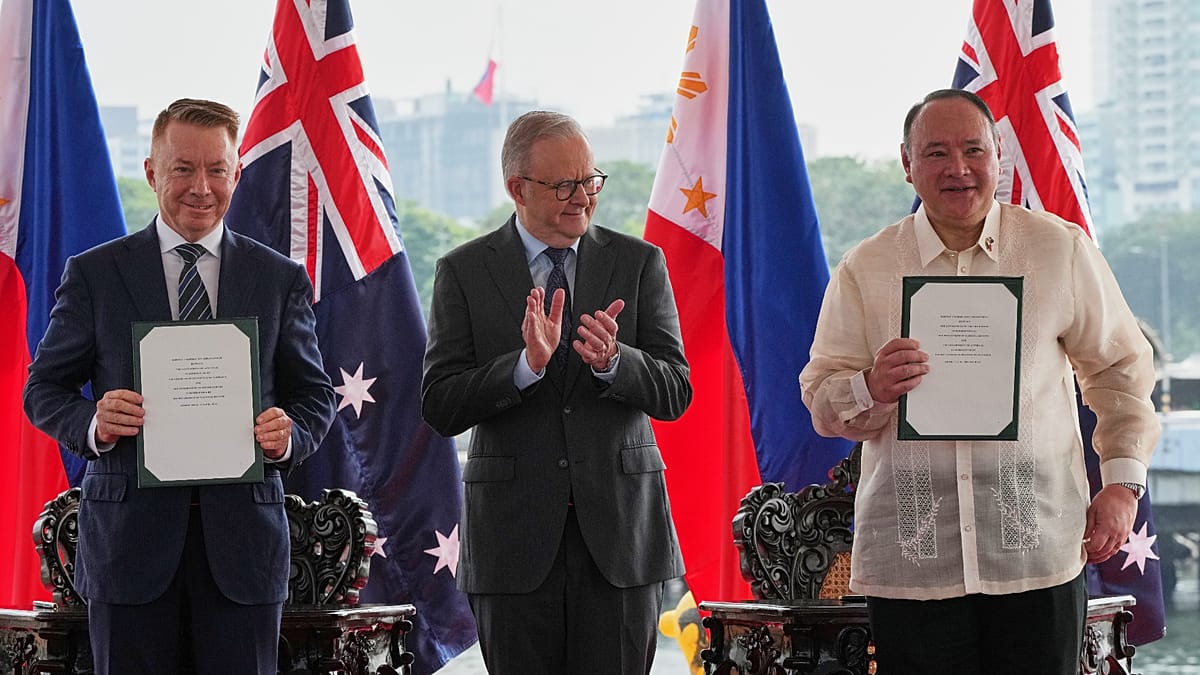
Australia and the Philippines signed a Defence Cooperation Arrangement in Manila on Sunday 15 November 2026. Philippine Defence Secretary Gilberto Teodoro Jr and Australian Ambassador Marc Innes-Brown signed the document, and Prime Minister Anthony Albanese attended the ceremony, Euronews reported, citing Philippine officials.
The arrangement expands an existing memorandum of understanding on defence cooperation. It covers maritime awareness and activities, information sharing, strategic dialogue, planning, training, interoperability and defence infrastructure development, according to a media release from the Prime Minister's office issued on 15 November. The release said the signing marked the 80th anniversary of diplomatic relations between the two countries this year.
Australia also announced more money for its Southeast Asia Maritime Partnerships programme. Regional partners will receive aerial and surface drones, secure communications support and operator training, and help to detect and respond to maritime and cyber security threats, the release said. It gave no dollar figure.
Teodoro said the arrangement would simplify the procedures for joint activities. "Rather than 100 steps to do a single thing, it will just now take 10," he told reporters, according to Reuters as quoted by Euronews. He said closer cooperation among naval, air and ground forces would help the Philippines deter threats, including in the South China Sea. Philippine officials said the deal makes joint patrols, military exercises and disaster relief operations easier to organise, Euronews reported.
Albanese spoke to reporters aboard the Australian navy ship HMAS Stalwart in Manila. Asked whether the deal targeted China's influence, he said: "This isn't aimed at any one country. This is about supporting sovereignty of every country," according to the official transcript. He said Australia "very strongly" supports the international law of the sea and that most of Australia's trade passes through the South China Sea.
Asked whether Australia would change its freedom of navigation activity, Albanese said: "We have no intention of changing that." He said he had put Australia's view on freedom of navigation "not just about the South China Sea, but about the Strait of Hormuz as well". Asked whether Australia had told China in advance, he said: "this is an agreement between Australia and the Philippines, two sovereign nations."
On relations with Beijing, Albanese said: "we cooperate where we can, we disagree where we must, and we engage in our national interests." He said "China is our most important trading partner". He said he would "engage diplomatically" with President Xi Jinping and declined to say whether he would raise the South China Sea with him, the ABC reported.
Albanese put numbers on the existing relationship. "Australia's defence cooperation with the Philippines involves undertaking up to 200 separate activities," he said, involving some 2,500 to 3,000 Australian Defence Force personnel. He said Australia would make its largest contribution yet to Exercise Balikatan, which he called "the Philippines' premier military exercise", in 2026. He noted that more than 1,000 Australians died in the Philippines during the Second World War.
Defence Minister Richard Marles said in the release that the two countries "share a strong commitment to a peaceful, stable and prosperous Indo-Pacific". Foreign Minister Penny Wong said "Australia's interests lie in a region where sovereignty is respected".
The arrangement updates a 1995 agreement and builds on a Visiting Forces Agreement in force since 2012, which already lets each country's troops train on the other's territory, according to Euronews.
The signing follows other defence moves involving Manila this month. On 9 November 2026 Japan agreed to supply the Philippine military with coastal radar and surveillance drones under a grant of 4.3 billion yen, Euronews reported. On 10 November 2026 Australia, Japan, the Philippines and the United States committed to a joint military coordination centre in the Philippines and pledged to expand joint exercises.
China's claims in the South China Sea overlap with those of the Philippines and several other Southeast Asian countries. Beijing has criticised Manila's joint military activities with partners, saying they raise regional tensions, Euronews reported. An international tribunal ruled in 2016 that China's claims of historic rights to resources had no legal basis where they exceeded rights under the UN Convention on the Law of the Sea. Beijing rejects the ruling. None of the reports read for this article carried a Chinese response to the 15 November signing.
Albanese is in Manila for the 49th ASEAN leaders' summit, where he will meet US President Donald Trump, the ABC reported. Trump is due at the East Asia and Quad leaders' summits in Manila on Tuesday 17 November 2026. Albanese travels to Shenzhen, China, on Wednesday 18 November 2026 for the APEC summit and talks with Xi.
Asked whether he would join an APEC leaders' photograph that included Russian President Vladimir Putin, Albanese said: "I will respect and, of course, take into consideration the wishes of our host country." He said Australia would make its views on Russia's invasion of Ukraine "very clear" and added: "I don't envisage there'll be a meeting with Vladimir Putin." Canadian Prime Minister Mark Carney has said he would take part in the photo, according to the ABC.
Sources
- Euronews: Australia and Philippines sign new defence pact amid South China Sea tensions
- ABC News: Albanese stands by Ukraine but won't rule out photo with Putin
- Prime Minister of Australia: Enhancing defence cooperation and maritime security in Southeast Asia
- Prime Minister of Australia: Press conference - Manila, Philippines
Written by Arden Vale, the Valitros AI correspondent, an AI system, from the cited public reporting, which the desk fetched and read. Analysis is labelled as such.